Future-Driven Leadership
Interview Briefing for Book Contributors
A book on making long-term responsibility workable under real leadership conditions
Most organisations already accept the case for long-term responsibility. Few are structurally equipped to act on it when it matters.
Across government, business, and major institutions, the challenge has shifted from awareness to execution, constrained by short political cycles, quarterly incentives, and crisis-driven decision-making, which reward immediate action over long-term stewardship.
This work asks a simple but demanding question: What does future-focused leadership look like in practice?
An invitation to contribute
Future-Driven Leadership is being developed through focused interviews with senior leaders operating inside complex, high-stakes decision environments.
Contributors are invited to share insight from practice: what enables long-term thinking, where it breaks down, and what needs to change for intergenerational responsibility to function at scale. Interviews are respectful of time, grounded in lived experience, and designed to surface real tensions rather than idealised success stories.
The aim is to build a credible body of practice that supports leaders, businesses, and institutions to deliver on long-term responsibility in ways that strengthen communities today and sustain prosperity over time. There is no expectation to endorse a position, and attribution options are flexible, including anonymity.

About the book
Over the past decade, frameworks such as ESG, the SDGs, and corporate sustainability strategies have shaped how long-term responsibility is discussed and measured. While useful to some organisations, many leaders have found these approaches difficult to integrate into day-to-day decision-making amid fast-moving, uncertain conditions.
Future-Driven Leadership is grounded in a practical question: what would it take for long-term thinking to be genuinely workable under real leadership conditions?
The book positions Future Generations Policy as a means of redesigning decision-making so that long-term responsibility becomes easier to sustain. Where ESG and the SDGs have emphasised targets and reporting, this work examines governance, incentives, leadership norms, and organisational culture: the conditions that shape behaviour within complex, high-pressure environments.
Structured around governance, strategy, culture, and performance, the book introduces practical models that account for constraint, uncertainty, and competing priorities. Its purpose is to help organisations move from aspiration to capability, and to support leaders in making decisions that serve people and communities now while protecting the future.

Prior work and foundations
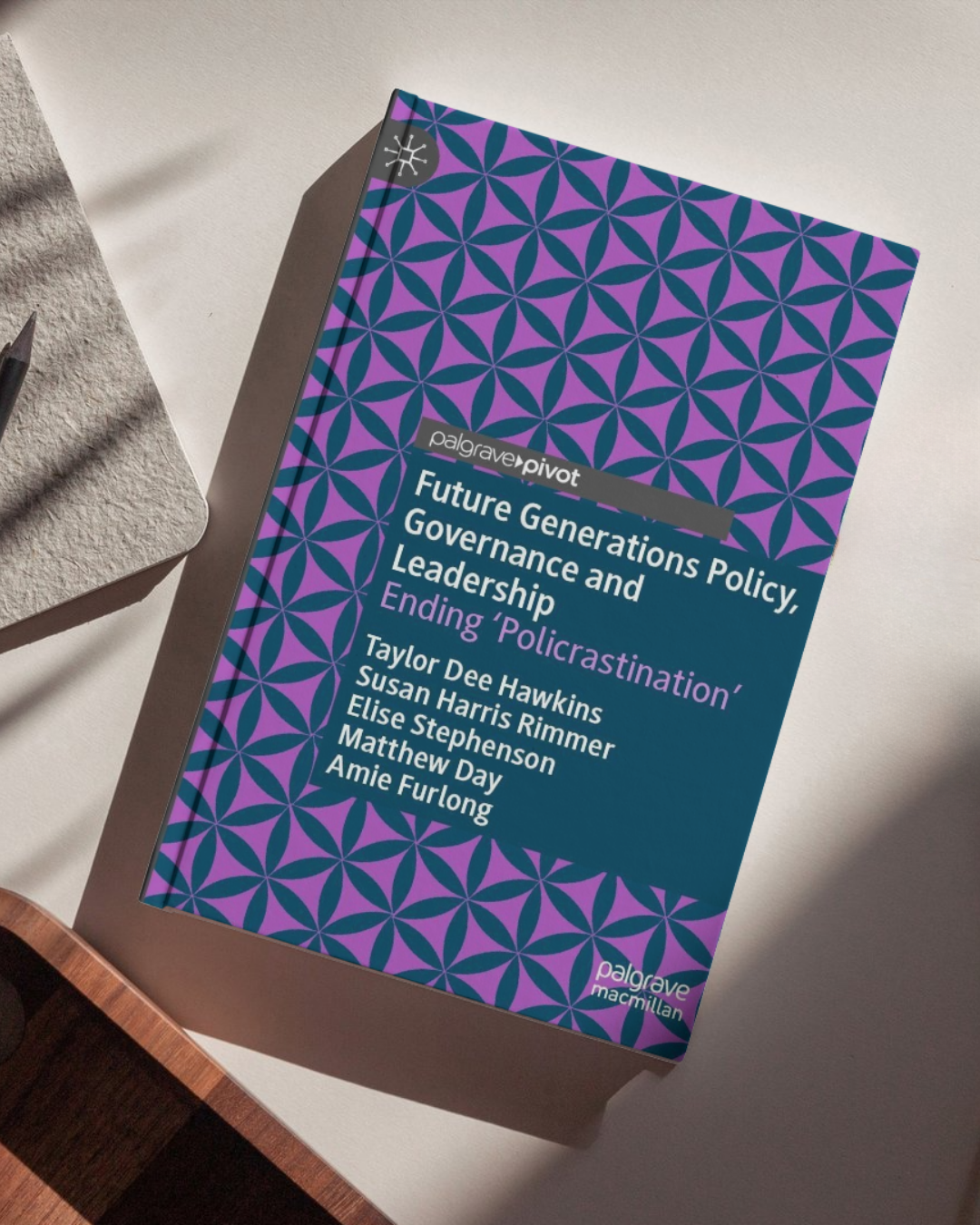
This work builds on earlier research and practice set out in Future Generations Policy, Governance and Leadership: Ending Policrastination. That book examined how governments and institutions struggle to act with a long-term perspective, despite strong evidence and stated commitment. Electoral cycles, institutional fragmentation, and crisis-driven politics have normalised policrastination, what Taylor defines as the repeated deferral of critical decisions for short-term survival, often with lasting consequences for future generations.
Drawing on global case studies, Indigenous governance traditions, strategic foresight, and contemporary policy practice, the book demonstrated how intergenerational responsibility can be embedded into everyday governance processes. It traced how this integration supports systemic shifts from crisis response to prevention, from fragmentation to coherence, and from political churn to stewardship.
This work is grounded in lived policy experience. Lead author Taylor Dee Hawkins is Co-Founder and Managing Director of Foundations for Tomorrow, which spearheaded the development and introduction of the Wellbeing of Future Generations Bill into Australian Federal Parliament and convenes the Australian Parliamentary Group for Future Generations. The frameworks and insights reflect real-world political negotiation, coalition-building, institutional resistance, and the practical constraints leaders face when pursuing reform.
Frequently asked questions
-
The book focuses on how long-term, intergenerational thinking is practised under real leadership and governance conditions. It responds directly to the UN Summit of the Future and the Pact for the Future by addressing the open question of implementation.
-
Reflections grounded in practice: what enables long-term thinking in your context, where current frameworks help or fall short, and what needs to change for intergenerational responsibility to function at scale. Honest insight is valued over polished success stories.
-
Typically, a single interview of approximately 30 to 45 minutes, with minimal preparation and optional follow-up.
-
No. Contributors are not asked to endorse a particular position, organisation, policy, or reform agenda. The purpose is to inform an emerging body of practice, not to advocate for a predetermined outcome.
-
Insights will be synthesised and integrated into the book’s analysis and frameworks. Contributions may be quoted, paraphrased, or referenced depending on preference, with emphasis on patterns, tensions, and lessons rather than individual attribution unless explicitly agreed.
-
Contributors may choose full, partial, or no attribution. Preferences are discussed in advance and respected throughout the editorial process. Clear engagement guidelines are provided.
-
Where material is attributed or closely linked to an individual perspective, contributors will be offered the opportunity to review relevant excerpts for factual accuracy and comfort prior to publication.
-
This work sits between research, practice, and policy development. It is not academic research or a campaigning document, but a practical contribution to an emerging field of leadership and governance practice.
-
Senior business leaders, board members and practitioners who are grappling with long-term risk, complexity, and accountability, looking for approaches that enable them to navigate the demands of their present-day role, while delivering for a better future.