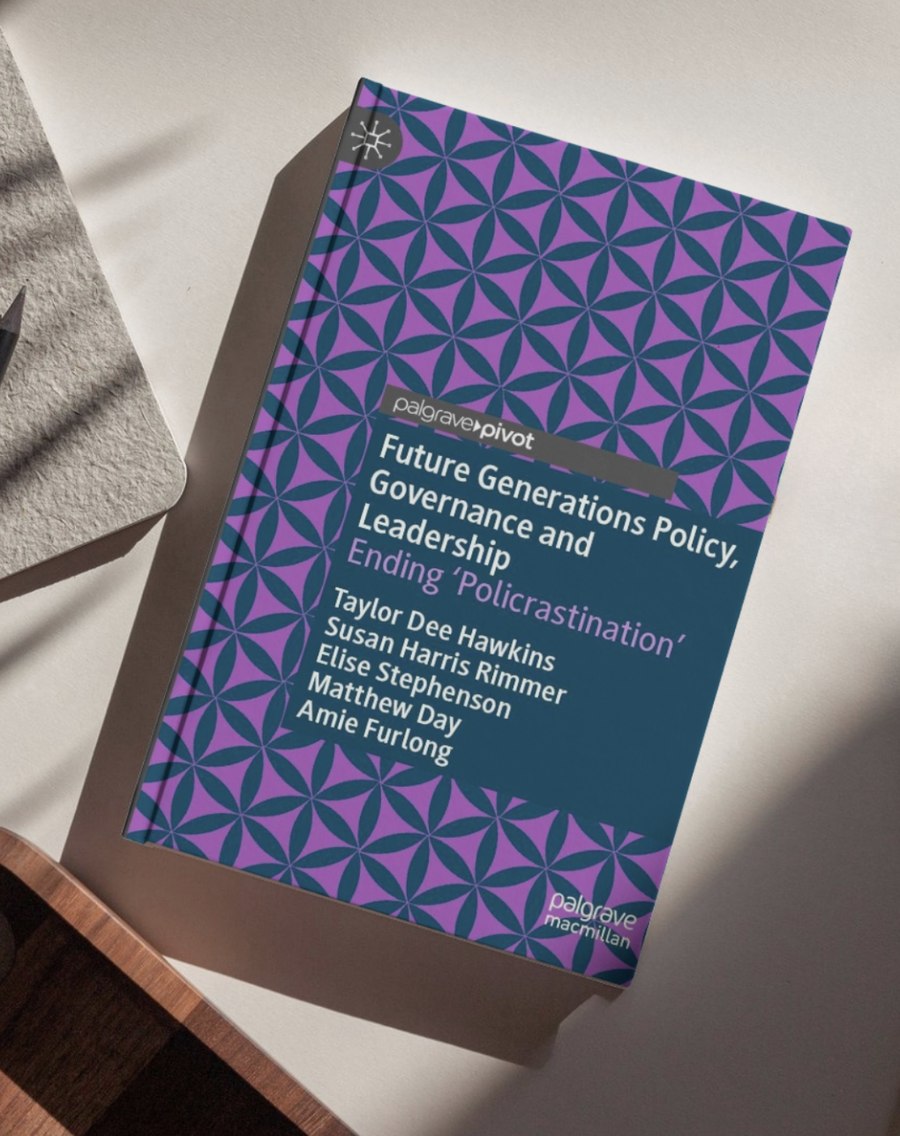
Future Generations Policy, Governance and Leadership: the book
Palgrave Macmillan · Palgrave Pivot · March 2026

Future Generations Policy, Governance and Leadership

Ending ‘Policrastination’

Taylor Dee Hawkins · Susan Harris Rimmer · Elise Stephenson · Matthew Day · Amie Furlong

Most of the decisions that will define the next century are being deferred in the name of the next quarter. This book gives that failure a name, policrastination, and a practical way out.

Po·li·cras·ti·na·tion noun

The systematic deferral or dodging of critical policy decisions for short-term political gain, often at the expense of future generations.

See also: climate inaction, housing crisis, deferred reform.

Explore policrastination.org

You may not have heard of ‘policrastination’ before, but we know you’ve seen it, and felt its impacts on your own life.

Inventing words since 2025, with General Strategic

The argument

A practical playbook for governing as though the future has a seat at the table.

Drawing on global case studies and the authors’ work from local councils to the UN Summit of the Future, the book moves from diagnosis to design: a clear definition of Future Generations Policy, an ecosystem of reforms that make long-term thinking stick, and a four-pillar framework that any minister, board or department can start using today.

It is not utopian. It is strategic, grounded and implementable: an argument that long-term thinking is a discipline, not an aspiration, and that the institutions willing to build it will outperform those that won’t.

“Deferral and delay only push us further away from the future we want, and the chasm grows with every day we wait. It’s time to define a legacy that future generations will thank us for.”
From the book
The framework

The Future Generations Policy Framework

One of the first detailed definitions of what Future Generations Policy looks like in practice: four pillars that define intergenerational thinking and long-term impact inside everyday policymaking.

01

Long-term vision

Policies guided by an inclusive, regenerative vision of the future, reflecting shared societal aspirations, ethical responsibilities and cultural wisdoms.

Anchoring decisions in a shared vision builds legitimacy and moves governments from sustaining systems to restoring them.

02

Intergenerational fairness

Policies that avoid shifting harm or cost forward, sharing benefits and burdens fairly across and within generations.

Burdening the future erodes trust and fuels conflict; fairness across time is a foundation of sound, stable governance.

03

Systems synergies & future dividends

Policies that join up across portfolios and compound their benefits over time, rather than acting in silos.

Today's investments produce reinforcing, compounding returns: resilience and value that accrue for generations to come.

04

Adaptive governance

Policies built to learn, with foresight, feedback and monitoring designed to endure across electoral and budget cycles.

Foresight and feedback let governments adapt early, protect public value and stay relevant in fast-changing conditions.

Adapted from the four-pillar Future Generations Policy Framework in Future Generations Policy, Governance and Leadership (Hawkins, Harris Rimmer, Stephenson, Day & Furlong, Palgrave Macmillan, 2026), Ch. 7.

The ecosystem

Three dimensions of lasting change

No single reform is enough. Future Generations Policy works when three interconnected dimensions reinforce one another.

01

Systems & structures

The institutional architecture: adjusted norms, dedicated institutions, parliamentary representation, legislation and constitutional measures.

02

Culture & community

The public narratives, education and civic dialogue that make long-term thinking a shared, everyday expectation.

03

Individual leadership

Leaders supported, incentivised and held accountable for the long view: the three levers of support, incentivisation and accountability.

Legal frameworks without cultural support are ignored. Cultural shifts without institutions don’t last. Leadership without structure stays individual. The most effective approaches work across all three at once.

Adapted from the three-dimension ecosystem model in Future Generations Policy, Governance and Leadership (Hawkins, Harris Rimmer, Stephenson, Day & Furlong, Palgrave Macmillan, 2026), Ch. 6.

Inside the book

What the book explores

  1. 01

    Future Generations Policy: naming polycrisis and ‘policrastination’.

  2. 02

    Defining the path forward: who future generations are, and how far ahead we look.

  3. 03

    Why this matters: the ‘fragile now’ and the high-stakes future.

  4. 04

    A journey of rediscovery: the timeless, First Nations ethic of intergenerational care.

  5. 05

    A world already in motion: the global movement for future generations.

  6. 06

    An ecosystem approach: the three dimensions of lasting change.

  7. 07

    A framework for everyday policymaking: the four pillars, and a tool to apply them.

  8. 08

    Australia's moment to lead: ten features of an ideal testing ground.

  9. 09

    Real-world stakes: AI, climate, and the intergenerational pact.

  10. 10

    A new social contract: a roadmap, and becoming the good ancestor.

The same pattern repeats across every sector: the decisions that matter most never move at the speed of an election cycle, which is exactly why they need leaders who think, and act, across generations.

Climate tipping points do not respect electoral cycles. Infrastructure investments shape cities for decades. Education policies determine workforce capabilities a generation from now. Social cohesion takes years to build and moments to destroy.
From the book
The authors

Written by

Taylor Dee Hawkins

Foundations for Tomorrow, Sydney

Susan Harris Rimmer

Griffith Law School, Griffith University

Elise Stephenson

Global Institute for Women’s Leadership, ANU

Matthew Day

Griffith Law School, Griffith University

Amie Furlong

Foundations for Tomorrow, Perth

Published by Palgrave Macmillan (Palgrave Pivot), an imprint of Springer Nature, March 2026. The framework, ecosystem model and book content presented on this page are © the authors and Palgrave Macmillan, and are adapted here with acknowledgement of the source.

Endorsements

What leaders are saying

“For leaders, policymakers, campaigners, and citizens who believe we owe it to future generations to do better, this book is essential reading. It is rigorous, hopeful, and practical. Most importantly, it reminds us that while the challenges before us are immense, the power to change course is in our hands, if we have the courage to act with the long term in mind.”
Sophie HoweInaugural Future Generations Commissioner for Wales · Cardiff, Wales
“Ending ‘Policrastination’ pinpoints Australia’s moment to lead. At a time of multiple, seemingly intractable deep-set challenges, this book gifts legislators and policymakers a pathway forward. Hawkins and co-authors are compelling: the challenge before us is not simply balancing current and future interests but recognising how deeply intertwined they truly are. The book not only identifies the problem with leadership, policymaking and governance but the tools we need to end policrastination and move forward to a more equitable future.”
Sophie LewisFormer ACT Commissioner for Sustainability and the Environment · Canberra, Australia
“Though we differ on some specifics, I share this book’s commitment to long-term thinking: from acting on climate change, to investing in early childhood, to strengthening Australia’s international engagement. It challenges us to be better ancestors, and offers plenty of ideas worth debating and acting on.”
The Hon Dr Andrew Leigh MPAssistant Minister for Productivity, Competition, Charities and Treasury · Canberra, Australia
title

Future Generations Policy, Governance and Leadership: Ending ‘Policrastination’

authors

Taylor Dee Hawkins, Susan Harris Rimmer, Elise Stephenson, Matthew Day & Amie Furlong

publisher

Palgrave Macmillan (Palgrave Pivot)

release

March 2026

isbn

978-981-95-4172-0 · 978-981-95-4173-7 (eBook)

doi

10.1007/978-981-95-4173-7