There is a particular way power speaks when a system is tired. The language becomes grand and final, offering resolution without process and certainty without clear means to deliver it.
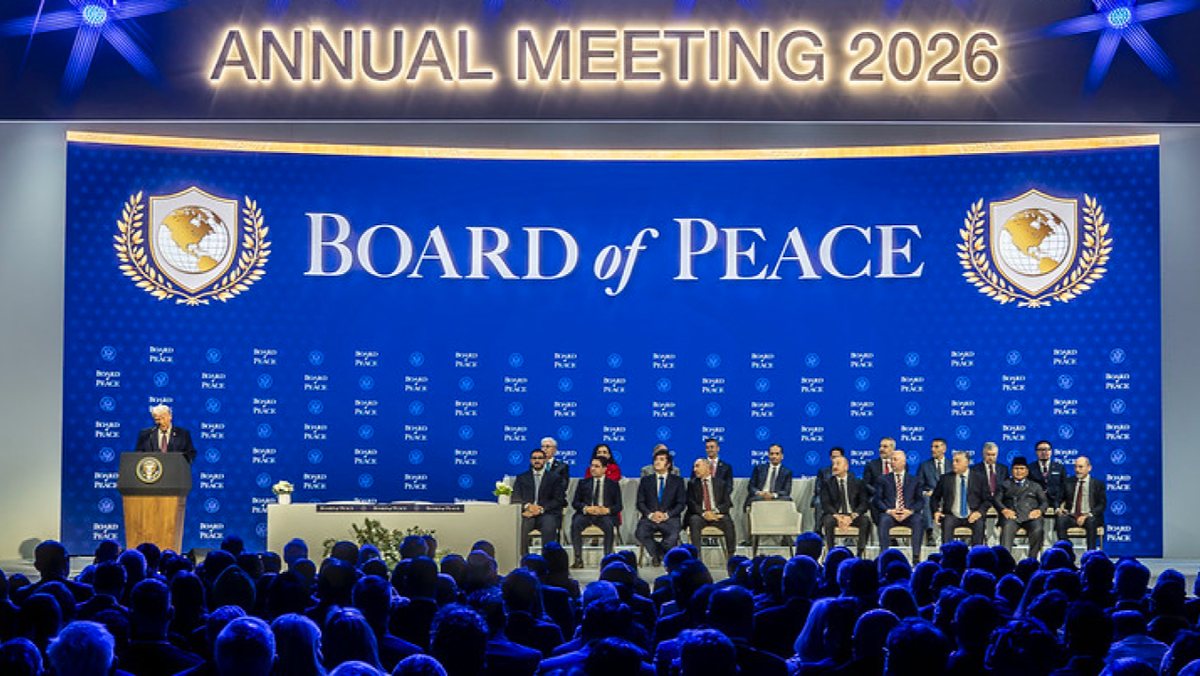
At the World Economic Forum’s Annual Meeting in Davos, I witnessed Donald Trump introduce the “Board of Peace” in exactly this mode. It was framed as decisive action in an era of exhaustion, and presented as a way around the visible struggle of existing channels to contain conflict as it spreads and hardens.
In moments of grief and instability, such offers are difficult to resist. Many people are no longer craving perfection. They are craving interruption, a lower bar that leaves the door open for theatre over capability.
The significance of the Board of Peace is not confined to whether it ultimately delivers the peace it claims to pursue. It lies in what its emergence reveals about the moment we are in.
Legitimacy alone no longer persuades. When institutions cannot act in ways aligned with the urgency of our landscape and volatility of our media, visible action begins to stand in for demonstrable capacity. Narrower, faster, and more dangerous forms of coordination start to feel acceptable, even necessary, when shared systems appear unable to move in time.
We have seen this pattern before, across regions and crises. When institutional failure accumulates and violence or instability becomes ambient, public patience thins. Under those conditions, leaders who move fast, concentrate authority, and sidestep established institutions are often welcomed, not despite the departures from procedure but because of them. Visible action becomes proof enough.
The early effects can sound compelling. The language suggests order returning, control being asserted, momentum replacing paralysis. But this is perception, not proof. The promise of speed is presented as if it were evidence of capacity. What is actually being offered is a trade: durable capability set aside in favour of concentrated authority, and peace reframed as decisiveness and order rather than accountability and resilience. When systems fail for long enough, people accept shortcuts not because they are naïve about the risks, but because those risks feel abstract compared to the psychological relief of motion.
This is the risk the Board of Peace exposes.
If peacemaking, leadership, and collaboration are to work under these conditions, reassurance, familiar language, and steadily implemented good intentions will not be enough.
What is required is intervention: a break with habits that reward symbolism over function. Interruption: a willingness to change incentives that privilege visibility over coordination and follow-through. And a rethink of the basics: where authority actually sits, how capacity is built and sustained, and how legitimacy is earned through delivery rather than declared in advance.
The capability problem underneath the peace problem
Peace often fails in public discourse because it is treated as a preference, not a capability.
We talk about peace as a posture, sentiment, or summit outcome, then act surprised when it collapses under pressure.
Durable peace has always been built, not declared. Built through institutions that can prevent escalation, manage grievance, enforce restraint, and invest in reconstruction without seeding the next conflict.
That work is rarely elegant. It looks more like infrastructure than inspiration. It depends on mandates that hold and budget lines that survive political turnover, and leaders trained to govern in ambiguity rather than perform certainty. This is where long-horizon thinking matters most, not as a moral flourish but as operational discipline. Ignore second-order effects, and today’s solutions reliably become tomorrow’s crises.
A model that centralises authority and treats permanence as purchasable may move quickly, at the cost of embedding instability. It can accelerate decisions while weakening the shared constraints that prevent the powerful from defining peace solely on their own terms.
The Board of Peace is a mirror
It reflects exhaustion with repeated failure, and a growing willingness to trade shared constraint for the feeling of control. It reflects institutions that can still narrate their purpose but struggle to exercise it. And it reflects a moment in which performance is mistaken for power, and decisiveness for capacity.
The response cannot be nostalgia for an order that no longer holds. But it also cannot be surrendered to the idea that only speed matters.
Peace cannot be rebranded into existence. It has to be built in crisis and demands the dedication of leaders capable of governing without false certainty, the fortitude of institutions designed to act before legitimacy evaporates, and publics willing to demand more than motion, confidence and theatre.
Because when we lower the bar to anything that looks like action, the promise of peace evaporates, rather than accelerates.
So the question this moment leaves us with is not whether we want peace badly enough. It is whether we are willing to build the capacity it actually requires, or if we will keep accepting substitutes until the real thing is no longer available at all.